
I’m back from holiday in Morzine. While I was there I hired a Mountain Buggy and took my little one out running. Two very different routes. Several unplanned discoveries. And by the time I got back from each one, I was thinking about writing. Because of course I was – welcome to my brain.
The day I planned as one run and lived in instalments
The plan was straightforward: run up to Lac de Montriond, have a swim, run back. I mapped it out, checked the elevation — 46m, manageable — and off we went.
It was 463m. Hello, inattentive ADHD, lovely of you to join us.
The morning leg — 4.89 km, 1h 2m — was what I would describe as a committed power walk up trails that were a bit tight for a buggy and almost certainly designed for hill walkers. My description at the time: “That was tougher than expected and more of a power walk. Some trails a bit tight with the buggy… worth it for the reward lake swim.”
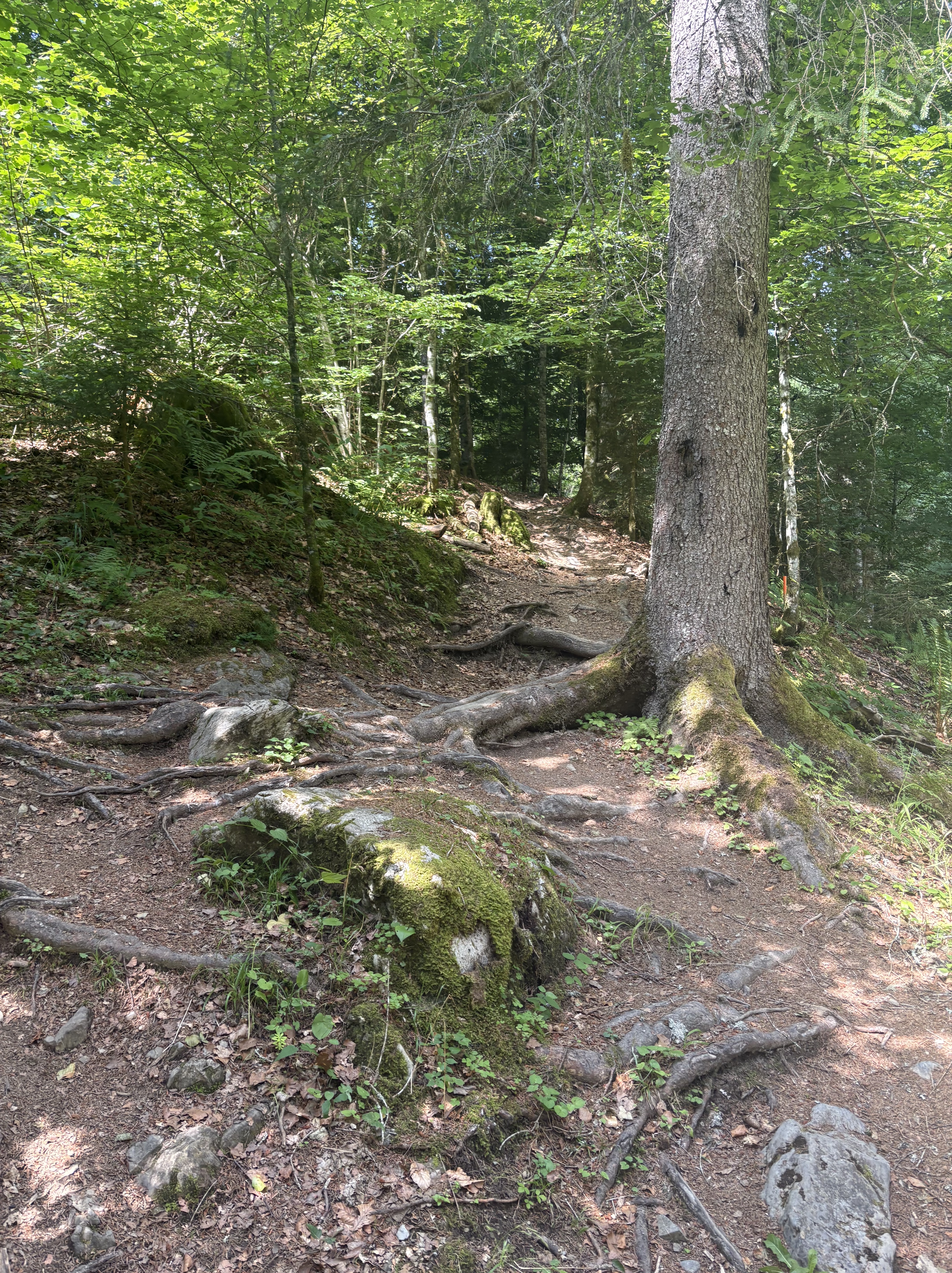
The lake swim was absolutely worth it. And then, on the descent back down those mountain biking trails, my little one fell asleep. I still don’t entirely understand how. The buggy was bouncing over rocks and roots on a gradient that had me concentrating very hard on my foot placement, and he was just… out. Peaceful. Completely unbothered. I was not unbothered. But we made it down.
The afternoon loop around the lake and back to Morzine — 8.21 km, 1h 9m — was the more manageable second half of what I’d originally planned as one run. “Lapped the lake and found the scenic route back. That hire buggy did a lot of good work today…”
It really did.
Lesson 1: Check the elevation. Actually check it.
There is a meaningful difference between 46 and 463. In running, that difference is felt in your legs for approximately three days afterwards. In writing, the equivalent is scanning a brief, a word count, a journal scope, or submission guidelines and thinking you’ve read them — when actually you’ve skimmed them and filled in the gaps with what you hoped they said.
The fix isn’t to feel bad about it. The fix is to slow down at the start, read again, and — if your brain works the way mine does — read it out loud, or ask someone else to confirm what it actually says before you commit. A second pass before you begin saves a lot of unnecessary effort once you’re already deep in the ascent.
Lesson 2: A big project is often best understood in stages.
I had mapped the whole day as one run. In reality, I did it in two legs with a swim in the middle, and that break made the whole thing possible. I got to the lake, recovered, recalibrated, and then the afternoon felt genuinely manageable — because I wasn’t trying to hold the entire thing in my head at once.
A thesis, a grant application, a literature review — these are all routes that look one way on paper and feel very different once you’re in them. Breaking them into stages, with genuine stops to recover and recalibrate in between, isn’t weakness. It’s how you actually get to the lake and back.
Lesson 3: Trust your experience on the scary bits.
On those descents — the ones that were clearly designed for mountain bikes rather than running buggies — I had a choice: panic, or trust what I know. I’ve run trails. I know how to read terrain. The situation was unfamiliar, but my experience wasn’t. We got down.
Writing in a new genre, for a new audience, or at a higher stakes level than you’re used to can feel exactly like that. The form is unfamiliar — a grant application, a policy brief, your first journal article — but your knowledge isn’t. Your ideas aren’t. The research is yours. Trust what you’ve already built.
Lesson 4: Know your kit — and know its limits.
The hired Mountain Buggy was a revelation. Chunky tyres, proper suspension, genuinely built for rough terrain. My own running buggy would not have survived Lac de Montriond. The right tool made the difference between a difficult-but-doable outing and a disaster — and between a child who sleeps peacefully through rocky descents and one who very much does not.
Writing tools matter too, and knowing their limits matters just as much as knowing their strengths. A grammar checker is brilliant for certain things and useless for others. A reference manager is a gift until you don’t check the output and the citation is wrong. AI tools can help you think, draft, and edit — but the intellectual decisions, the argument, the accuracy: those remain yours. Use tools built for what you actually need. Then check the output, because even the best kit doesn’t replace your judgement.
Les Bords de Dranse — 14.57 km, 2h 27m
The second route was a different kind of adventure entirely. Les Bords de Dranse follows the river through the valley, along paths the signage politely describes as “voies rustiques” — rustic routes — which is French for “not particularly designed for a running buggy.” My Strava description: “Paths not quite made for a running buggy + an overall incline back. Beautiful scenery and the best running buddy!”
The key detail I had failed to register in advance: the route goes down by the river and since I had planned an out-and-back run, it also comes back up. 14.57 km and nearly two and a half hours later, I had learned this very thoroughly.

Lesson 5: Reconnaissance is not failure. It’s efficiency.
I headed off and trusted it would work out. Sometimes that’s fine. Sometimes you’re at the bottom of a valley wondering exactly how far back up the other side you now have to push a buggy. A bit of scouting beforehand — checking what the return looks like, asking someone who’s done it — saves a significant amount of effort later.
In writing, we do this all the time. We start drafting before we’ve really planned. We submit to a journal without properly checking the scope. We send a piece off before we’ve read it back. Sometimes it works out. Sometimes you end up committed to a 14 km route with an unexpected climb home.
Reading a few published pieces in your target journal before you write, sketching an outline before you draft, doing a readthrough before you share — none of that is slow. It’s the preparation that gets you home without needing to lie down on the path.
Lesson 6: Some routes are just harder — and that’s information, not failure.
The Dranse run was slower — 10:05/km versus 8:26/km for the lake loop. The terrain was rougher. The buggy was being navigated through paths it wasn’t designed for. The pace reflected the conditions, not my capability.
Writing has its version of this too. Some pieces just take longer. A literature review through genuinely contested territory. A section where the argument keeps shifting. A chapter you have to write your way into rather than planning your way through. Slower progress on those sections isn’t a sign something has gone wrong — it’s a sign you’re doing the actual work. The pace reflects the terrain.
What the mountains always remind me
Two runs. One misread elevation. One sleeping child on a mountain bike descent. One surprise river climb. Six things I already knew about writing but apparently needed a Mountain Buggy and the French Alps to remind me of.
Running in the mountains has a way of stripping things back. You have to be present. You have to make decisions with the information you have. You can’t outsource the hairy descent to anyone else — and apparently neither can a small child, who will simply sleep through it and leave you to manage alone.
Writing is the same. You can have all the support in the world — good tools, a writing community, a Power Hour of Writing to protect the time — but the thinking, the decisions, the voice: those are yours. And you are probably more capable of the terrain than you think, even when the elevation turns out to be 463m.
What’s the most unexpected place you’ve found a writing lesson? I’d love to hear it in the comments.
AI Use Statement
AIR: Writing — A2 (Analytical support)
Claude (Anthropic) was used to help develop, structure and draft this post from notes, personal experience and Strava activity data shared by the author. All ideas, experiences, analogies and editorial decisions are the author’s own. The full draft was reviewed, edited and approved by the author before publication.

