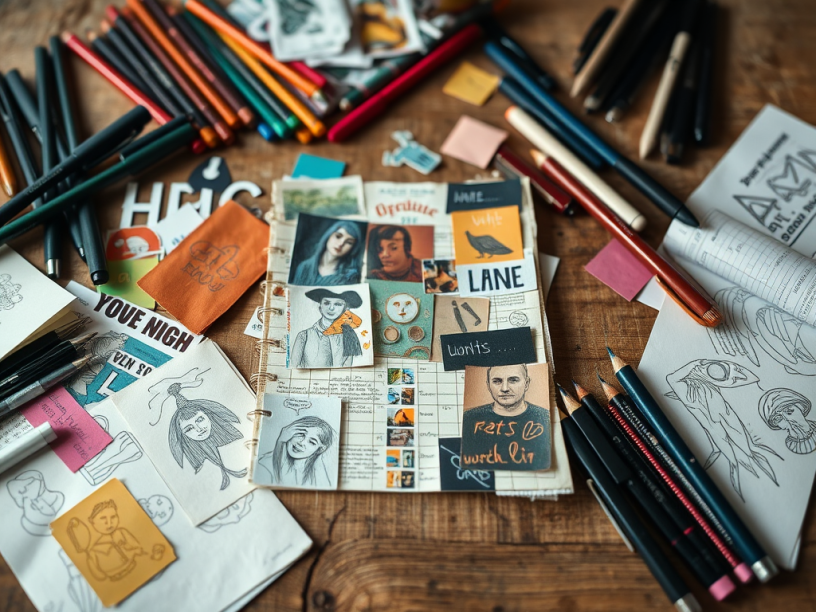
I’ve been thinking a lot lately about how we approach academic writing – and more specifically, how much of the writing process happens away from the keyboard. During a recent workshop for Academic Writing Month (AcWriMo), I introduced researchers to zine-making as a creative tool for thinking through their work. The response was brilliant, so I wanted to share the approach here for anyone who couldn’t make it or wants to give it a try at home.
Writing doesn’t always happen at a keyboard
Here’s something that took me ages to properly understand: writing happens when you’re walking and thinking, drawing connections, talking ideas through, reading and annotating, even sleeping on problems. The actual typing? That’s just documentation of thinking you’ve already done.
This realisation completely changed how I approach writing support. Academic writing doesn’t always need more formal instruction or another workshop on paragraph structure. Sometimes what we need is permission to step away from the pressure of producing perfect prose and explore our ideas in a completely different way.
What actually is a zine?
If you’re not familiar with zines, they’re self-published, small-circulation works that originated in punk and DIY culture. Think photocopied booklets, hand-drawn illustrations, cut-and-paste collages – anything goes, really. The beauty of zines is that they’re deliberately lo-fi and accessible. You don’t need special skills or expensive materials. A sheet of paper, some scissors, and whatever pens or magazines you have lying about will do.
For academics, zines can become:
- Personal research journals
- Visual thinking tools
- Conference reflection notebooks
- Idea exploration spaces
- Emotional processing aids
The key principle is this: low stakes, high creativity. There’s no right way to make a zine, and that’s precisely the point.
Why creative methods support academic thinking
Academic writing requires us to step away from formal language sometimes. We need space to process emotions alongside ideas, see our research from a different angle, make connections we couldn’t see before, and – crucially – give ourselves permission to play.
During the workshop, I had participants start with two warm-up exercises. The first was deceptively simple: write down as many adjectives about yourself as a writer or researcher as possible in 30 seconds. No thinking, just writing. Curious, tired, hopeful, messy, determined, confused, growing – whatever comes to mind.
The second exercise used a version of blackout poetry. Grab a page from any magazine or newspaper, find five to ten words that jump out at you, circle or cut them out, and arrange them into a phrase about your research. There’s no right answer – just play.
These exercises help bypass the internal editor that so often gets in the way when we’re trying to write “properly.”
Making your first zine
The classic one-sheet zine is wonderfully simple to make. Start with one sheet of A4 paper, fold it in half lengthwise, then fold it in half widthwise (what we call a hamburger fold), fold in half again, unfold to the hamburger fold, cut along the centre fold in the middle section only, refold lengthwise and push the ends together, then flatten into book shape. You’ve now got an eight-page mini booklet. Not quite sure – watch this How to make an 8 page zine out of a single sheet of paper video.
Of course, there are other simple styles too – accordion folds, stapled booklets, single sheets, sewn bindings. The format matters far less than what you do with it.
Prompts to get you started
For the workshop, I offered several prompts that participants could choose from or combine. Here are a few favourites:
Reflection prompts
- What’s challenging me right now in my research?
- What I wish I could tell my past or future self
- The story of my research journey so far
Exploration prompts
- My research in images and metaphors
- Questions I’m sitting with
- What I’ve discovered recently
Creative prompts
- My research as a landscape or map
- The feeling of writing, analysis, or fieldwork
- Conversations in my head about my work
Not quite right for you? You can create your own prompts using GenAI. Try asking Claude, ChatGPT, or Copilot something like: “I’m creating a six-panel zine about [your finding]. Suggest five different visual metaphors I could use to explain this concept.”
What to actually do while making
You might collage images that resonate, write fragmented thoughts or quotes, draw diagrams or doodles, mix text and images, leave white space, or make something completely abstract. Remember – this is for you, not for assessment or publication.
If you’re feeling stuck, try these techniques:
- Word mining: cut interesting words from magazines
- Visual metaphor: what image represents your research right now?
- Stream of consciousness: write continuously without editing
- Dialogue: create a conversation between ideas
- Timeline: map your research journey visually
- Colour coding: use colours to represent emotions or themes
The most important thing I tell people is to trust your instincts, embrace “messy,” remember there’s no wrong way, accept that it doesn’t need to be finished, and know you can always make another.
Taking zines forward
So what do you actually do with a zine once you’ve made one? Well, there’s no pressure to do anything “with” it at all. You might keep it private in your research journal, share it with trusted peers or supervisors, start a series documenting your journey, use it as a brainstorming tool before writing, or just let it sit and return to it later.
Some people find it useful to make zines as a regular practice – perhaps monthly or termly. Others create them when they’re stuck, to process feedback or milestones, for conference prep and visual planning, in collaboration with peers, or as rewards to celebrate completed chapters or papers.
The beauty of this approach is that it’s low cost but high impact. A sheet of paper and some pens are considerably cheaper than a writing retreat, but the thinking work it enables can be just as valuable.
What participants noticed
During the workshop reflection, people shared some really insightful observations. Several noted how different working with their hands felt compared to typing – there was something about the physical, tactile process that shifted their thinking. Others were surprised by what emerged when they gave themselves permission to be less formal and more playful.
One thing that kept coming up was how freeing it felt to create something that didn’t need to be perfect, that wasn’t being assessed, that was just for them. In academia, where so much of what we produce is scrutinised and evaluated, having a space for genuine exploration – mess and all – can be quite profound.
Give it a go
If you’re curious about trying this yourself, I really encourage you to have a go. All you need is a sheet of paper and whatever drawing or collaging materials you have to hand. Give yourself 30 to 60 minutes, pick a prompt that resonates, and see what happens.
The worst that can happen is you spend an hour thinking about your research in a different way. The best that can happen? You might discover connections you’d been missing, process emotions that were blocking your writing, or simply give your brain a break from the relentless pressure to produce perfect academic prose.
And that, in itself, is worth more than a sheet of paper and an hour of your time.
 Stephanie G Zihms, PhD