
Using Creative Writing to Combat Imposter Feelings
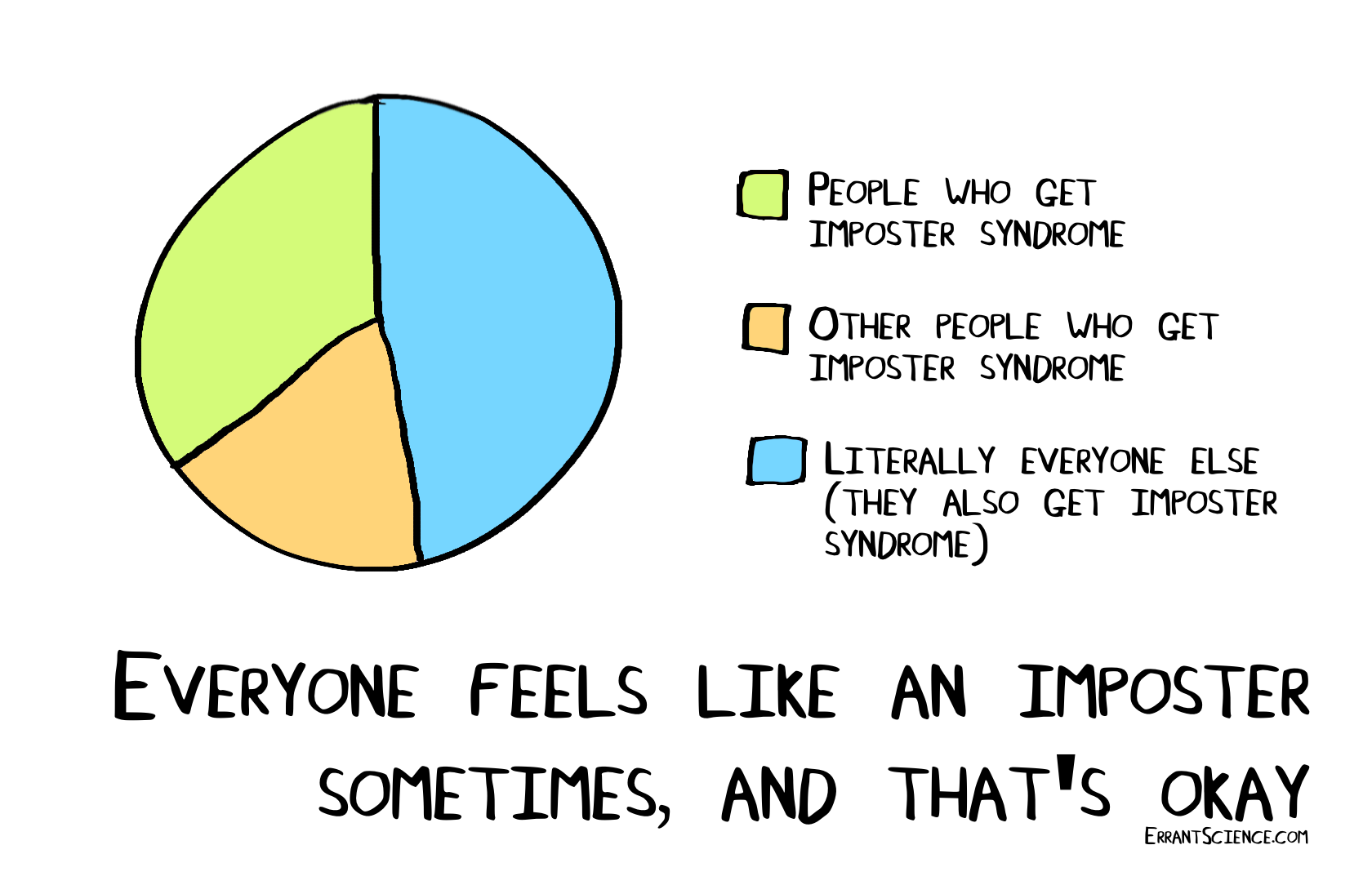
We’ve all been there – that nagging voice telling us we’re not quite good enough, that someone will eventually figure out we don’t belong. These imposter feelings are incredibly common in academia and professional settings, but that doesn’t make them any easier to deal with. There’s a brilliant pie chart showing that basically everyone experiences imposter feelings – you, other people, and literally everyone else. It’s funny because it’s true, and if nothing else, it reminds us we’re in very good company!
Why ‘imposter feelings’ not ‘imposter syndrome’?
You might notice I’m using ‘imposter feelings’ rather than ‘imposter syndrome’. This shift in terminology is important – it acknowledges that these feelings aren’t a personal failing or medical condition, but often a response to systemic issues in our working environments. The competitive nature of academia, constant peer review, and pressure to publish creates the perfect breeding ground for these feelings. By reframing this as feelings rather than a syndrome, we can start to see them as something we can work with rather than something that’s ‘wrong’ with us.
Acknowledging imposter feelings
Before we dive into creative solutions, it’s worth acknowledging that sometimes these feelings are telling us something important about our environment. Toxic work culture can be a real cause of imposter feelings. If you’re constantly feeling like you don’t belong or aren’t good enough, it might be worth examining whether the culture around you is supportive or whether it’s feeding those feelings.
Creative writing as a tool for managing imposter feelings
One approach I’ve found helpful is creative writing, specifically writing in role. I first encountered this technique at the International Creative Research Methods Conference in 2023, where Claire Coleman delivered a brilliant workshop called “Vanquishing the Imposter through Rewriting in Role”. The approach resonated so much with me that I’ve since adapted it for my own workshops at GCU.
This technique allows us to step outside ourselves and explore different perspectives, giving us a break from that critical inner voice. The beauty of creative writing is that everything goes – there are no rules, no right or wrong. It’s a space where we can play and experiment without judgement.
Try it yourself: Activity 1 – Writing as someone else
This workshop was inspired by Claire Coleman’s brilliant work on “Vanquishing the imposter through rewriting in role” (ICRMC, Manchester, 2023), and I want to share the activities we use so you can try them at home.
First, let’s warm up by creating a character from scratch. Look at the image of a simple blob person (or just imagine one). Now, pick one of these stock photo people – maybe someone sitting in a park with a camera, someone working at a laptop, an older person making a phone call, or someone in a library.
Write down:
- Things you notice or see about this person
- Things you imagine about them
- Their character traits
- Their age
- Their occupation
Now think about something this person would write about – a journal entry, a work report, or something else. Take 10 minutes and write a short piece (100-200 words) from their perspective.
How did that feel? Most people find this surprisingly freeing. Writing as someone completely different removes our self-judgement and lets us experiment with different voices and styles.
Activity 2 – Rewriting in role
Now for the main event. Let’s try writing in role about your actual work:
Step 1: Write something real (10-15 minutes)
Write 200-300 words about:
- Your research
- Your job
- A recent project
- A report you’re working on
Just write naturally, as yourself. Don’t overthink it.
Step 2: Create your character (5 minutes)
Now, imagine someone in your field or area of work that you look up to. This could be a famous researcher, a confident colleague, or even a fictional version of your future self. Build their character profile:
- How do I talk?
- How do I dress?
- How do I deal with difficult questions?
- How do I write/talk about my work?
- What’s my favourite colour?
- What’s my hobby?
- What’s my favourite food?
Get specific – the more detail, the easier it is to step into their shoes.
Step 3: Rewrite as your character (15 minutes)
Keep your imagined person in mind and rewrite your 200-300 words from Activity 2, but this time as them. How would they describe your research? What language would they use? What tone would they take?
Why does this work?
Writing in role gives us permission to:
- Express ourselves without self-censorship
- Try on different voices and perspectives
- Practice being more confident in our academic writing
- Step away from the constant self-judgement that can paralyse our writing
There’s something quite liberating about temporarily setting aside our own doubts and inhabiting someone else’s confidence, even if just on the page. When writing as someone else, we often find ourselves being more confident, more assertive, and – crucially – kinder to ourselves and our work.
Workshop feedback
When I’ve run this workshop, participants often report:
- Finding it easier to write confidently when “in character”
- Discovering language and phrases they can bring back to their own writing
- Realising they’re more critical of themselves than they would be of others
- Noticing how much the inner critic affects their usual writing
The most common challenge? Sometimes it’s hard to maintain the character throughout – we slip back into our own voice. That’s absolutely fine! The goal isn’t to permanently write as someone else, but to practice accessing a more confident voice.
Making it part of your practice
I recommend starting small – try writing a conference abstract or research summary as your chosen character. Set a timer for 15 minutes and just write. Don’t edit, don’t judge, just write as if you were that confident expert in your field.
Over time, you might find these confident voices becoming more natural in your own writing and thinking. It’s not about pretending to be someone else permanently – it’s about finding your own authentic academic voice through practice and play.
Other ways to manage imposter feelings
While creative writing can be helpful, it’s just one tool in our toolkit. Here are some other approaches that work well:
Tip 1: Acknowledge how you’re feeling – and remember that toxic work culture might be the cause, not you
Tip 2: Talk to others – you’ll be surprised how many share these feelings
Tip 3: Seek out feedback – it might be better than you think
Tip 4: Keep a ‘wins’ folder with positive feedback and achievements – I call mine my happy folder and dip into it when I need a boost
Tip 5: Take time to acknowledge your achievements and reflect – regular reflection helps you see your progress; journaling or using structured reflection can help
Tip 6: Look for a mentor or peer support – having people who get it makes such a difference
Tip 7: Focus on progress rather than perfection – celebrate the small wins along the way
Final thoughts
Remember, having imposter feelings doesn’t mean you’re an imposter. It often means you’re pushing yourself, learning, and growing – all good things! The key is not letting these feelings hold you back from sharing your important work with the world.
The creative writing approach might not work for everyone, and that’s fine. The important thing is finding strategies that work for you and being kind to yourself in the process. We’re all works in progress, and that’s perfectly okay.
What strategies have you found helpful for managing imposter feelings? I’d love to hear your experiences – drop a comment below or get in touch.
 Stephanie G Zihms, PhD