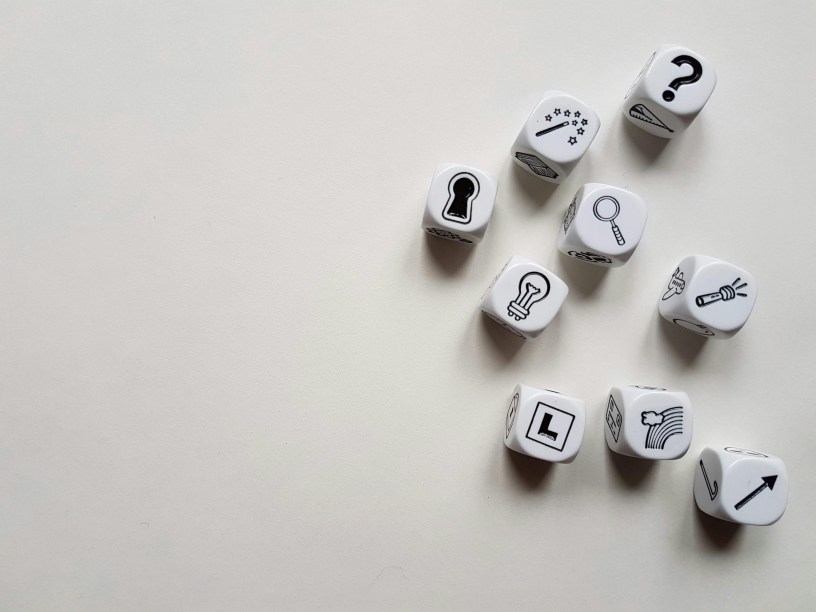
What is story completion?
Story completion is a projective technique, where respondents are given part of a story – enough to direct attention to a particular topic but not to hint at the ending. Story completion can be viewed as an innovative, exciting, and flexible method for qualitative researchers, and yet this method has not been widely adopted. Indeed, it is only recently that the method has come to prominence within psychology research, heralded as a method with “exciting promise” (Braun, Clarke, Hayfield, Moller, & Tischner, 2018) and described playfully by Clarke, Braun, Frith, and Moller (2019, p. 1) as “the best new method for qualitative data collection you’ve never even heard of.” Continue reading Story Completion: Storying as a Method of Meaning-Making and Discursive Discovery
I was introduced to this method at the International Creative Research Methods Conference in Manchester in September 2023, by Ash Watson’s session: Counter-futures: (re)imagining social change through creative writing workshops. I wondered if this method would work as a workshop to help overcome writer’s block. So this post focuses on this, however please explore how this creative method might work as part of your data collection and creation.
Writer’s block
is a non-medical condition, primarily associated with writing, in which an author is either unable to produce new work or experiences a creative slowdown.
Writer’s block has various degrees of severity, from difficulty in coming up with original ideas to being unable to produce work for years. This condition is not solely measured by time passing without writing, it is measured by time passing without productivity in the task at hand. Writer’s block has been an acknowledged problem throughout recorded history. (https://en.wikipedia.org/wiki/Writer%27s_block)
There are a range of tips available to help overcome Writer’s block
- Free writing
- Journaling
- Brainstorming
- Going for a walk
Why not try story completion to help with writer’s block
Think of this as a form or guided free writing or a way to kick-start your writing by having a specific and personalised prompt. Below are some stories I created (more on the how later).
- Read the stories shared below and pick the one that chimes with you the most
- Spend some time thinking about the character in the story. Maybe scribble down some notes
- Set a timer to 15 (or more) minutes and finish the story you selected
- Spend some time looking at your story, maybe share it with someone
Story A
Peter leaned forward, his eyes brimming with determination, as he tried to convince his advisor, Professor Claire Jameson, that his proposed research direction was the right way to go. “I understand it might seem unconventional, but the potential here is immense,” he explained, his voice filled with unwavering confidence. “The current data only hints at the true scope of our findings. If we delve deeper into this unexplored avenue, we could…
Story B
Dr. Michael Daniels stared at his computer screen, the words in the discussion section of his research paper appearing incoherent and disjointed. He had spent hours trying to make sense of the jumble of ideas and arguments, but the more he edited, the more convoluted it became. He closed his eyes, took a deep breath, and paced around his office. In his mind, he envisioned a new structure for the discussion section, one that would give his findings the clarity and impact they deserved. He grabbed a fresh sheet of paper and…
Story C
Dr. Thomas flipped through his meticulously organised research notes, his forehead furrowed with uncertainty. He had already outlined his research objectives, reviewed the literature, and collected a wealth of data, but the daunting task of writing the methods chapter left him paralysed with doubt. The thought of encapsulating the intricate procedures, equipment, and techniques he had employed in a coherent narrative felt like staring at an insurmountable mountain.
He sighed, realising that he needed to…
Story D
Emily’s desk was cluttered with stacks of research papers, each brimming with knowledge and insights from her field. She had spent weeks collecting a plethora of articles, journals, and books, but as she sat down to start her literature review, she felt overwhelmed by the sheer volume of information at her disposal. Where should she begin, and how could she structure this literary sea into a coherent, meaningful narrative?
Emily gazed at her computer screen, pondering the challenge. She knew that the literature review was…
Creating prompts or stories
Here are the prompts I used with ChatGPT to get the four stories
A: Can you provide me with the start of a story related to a PhD students is tying to convince their supervisor that their next steps are right?
B: One where a researcher can’t get their discussion section in order and wants to restructure it.
C: Could you add a prompt where a researcher is not sure how to start writing their methods chapter?
D: Can you create a story start about a researcher who is not sure who to start and structure their literature review?
If you want to create prompts to use that are more specific to your Writer’s block or a particular section where you are stuck – think about the below points to create your prompt:
- Think of a vague representation of why or where you are feeling stuck with your writing
- Create a prompt that reflects that scenario
- See what ChatGPT offers you. I had to cut the story prompts. You can just start where you want or ask ChatGPT to refine it
- Set your timer and start writing
Further resources
Why not share your prompts, stories and how this method worked for you in the comments.
 Stephanie G Zihms, PhD